Last week, a friend came up to me and said “ Australian bond yields have gone up to over 5%. Surely that must be an incredibly high rate. We can’t have that rate of interest for much longer.”
So, what I did was look back at the history of Australian bond yields since 1970. You can see this on the chart below. It shows a frequency distribution of Australian 10-year bond yields all the way back to 1970.
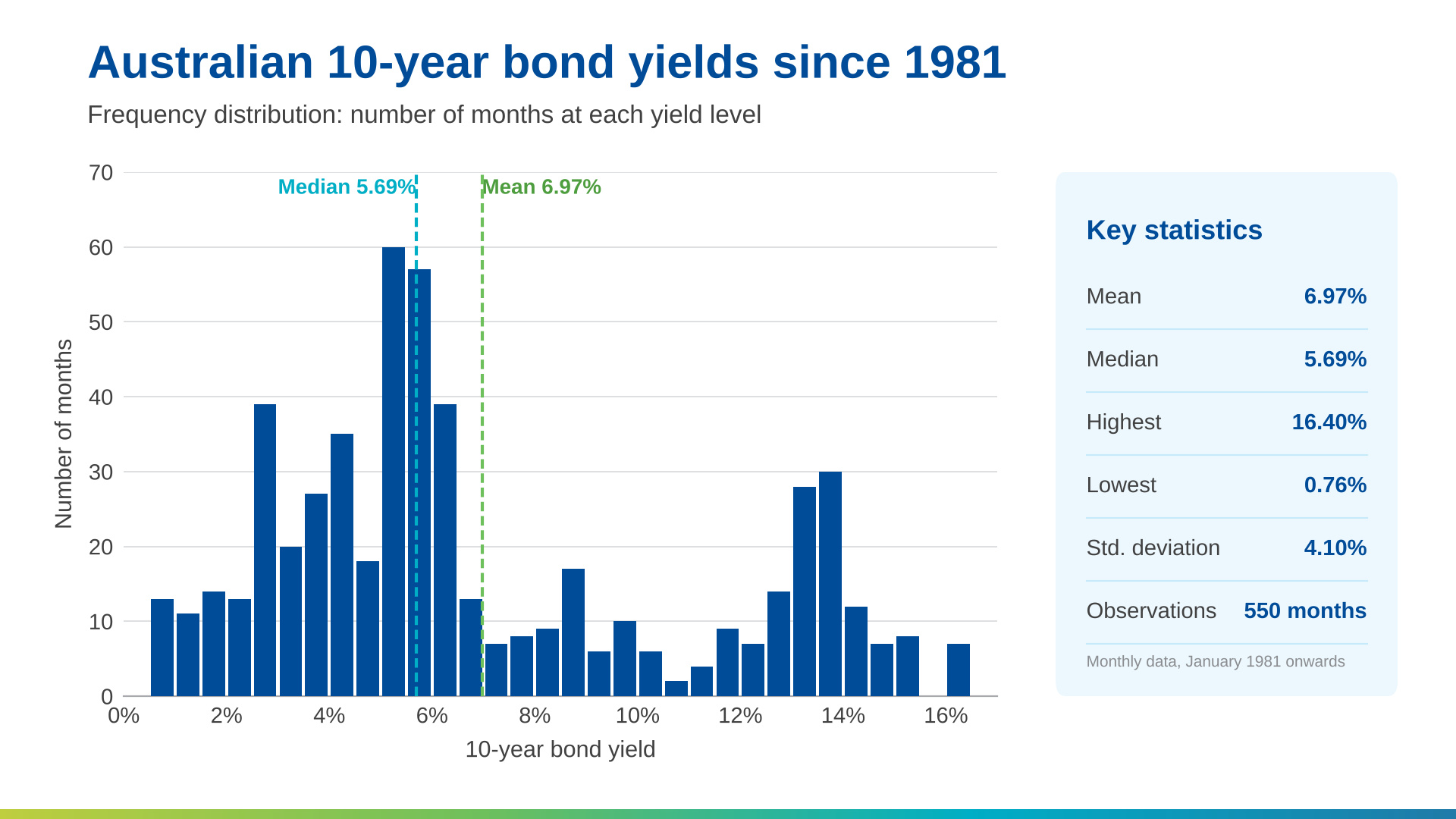
There are two distinct features in that distribution. One is a big concentration of time periods, or months, in which interest rates in Australia were between 5% and 6%. Indeed, the median of the entire period, that is, 50% above and 50% below, shows an Australian 10-year bond yield of 5.84%. So, tragically, it looks like interest rates in the 5% range are very common and are likely to be where our long-term interest rates might settle in the Australian bond market.
It’s really very interesting to look at how the Australian bond market is interrelated with other bond markets, like the US bond market and the German bond market. The Australian bond market raises its money on the US bond market, and this means that movements in US bond yields seem to happen before movements in Australian bond yields. So if US bond yields move up, Australian bond yields tend to move up afterwards. US bond yields have been moving up recently and Australian bond yields have also been moving up.
The US is increasingly raising money in the European bond market, so movements, particularly in German bond yields, now seem to lead movements in US bond yields.
The bond market tells us that part of our role in the national community is that our need for finance may be met by the savings of others in far distant lands.
The Australian Cash Rate
At the beginning of the year, I said that I thought the Australian cash rate would rise to 485 basis points by the end of the year.
That was a pretty radical comment at the time, but the reason I thought this was going to happen was because electricity prices would rise as government subsidies were removed, pushing up Australian inflation.
We can already see this in the CPI figures for August and September.
RBA Deputy Governor Andrew Hauser said last week that the problem is that businesses now have an expectation of continuing inflation at 3.6%. He said that expectation itself was a reason for a further increase in the Australian cash rate.
Today, with the release of the September CPI, we saw core inflation come in at exactly that rate, with the trimmed mean at 3.6% for September. As well there was an upward revision to the August trimmed mean from 3.5% to the same 3.6%.
It is now likely that we will now see a further increase in the cash rate to a target of 4.85%.
Hopefully, this will be the last time we need to see the RBA raise rates.
Want to discuss how this impacts your portfolio?
DISCLAIMER: Information is of a general nature only. Before making any financial decisions, you should consult with an experienced professional to obtain advice specific to your circumstances.