Today we want to look at the quite strong growth in the US economy at a puzzling time. It puzzling because we're getting strong growth in the US economy at a time when employment growth is really quite weak.
The normal place to look if an economy is growing ,is to look at employment. After all, more people in jobs, the larger the economy. But that's not what's happening in the US economy right now.
The US economy is growing, but job numbers look weak. When we look at the year-on-year growth of US payroll numbers for the year to July, we can see that US payrolls grew by only 0.19 of 1%, less than a fifth of 1%, for the year to that period.
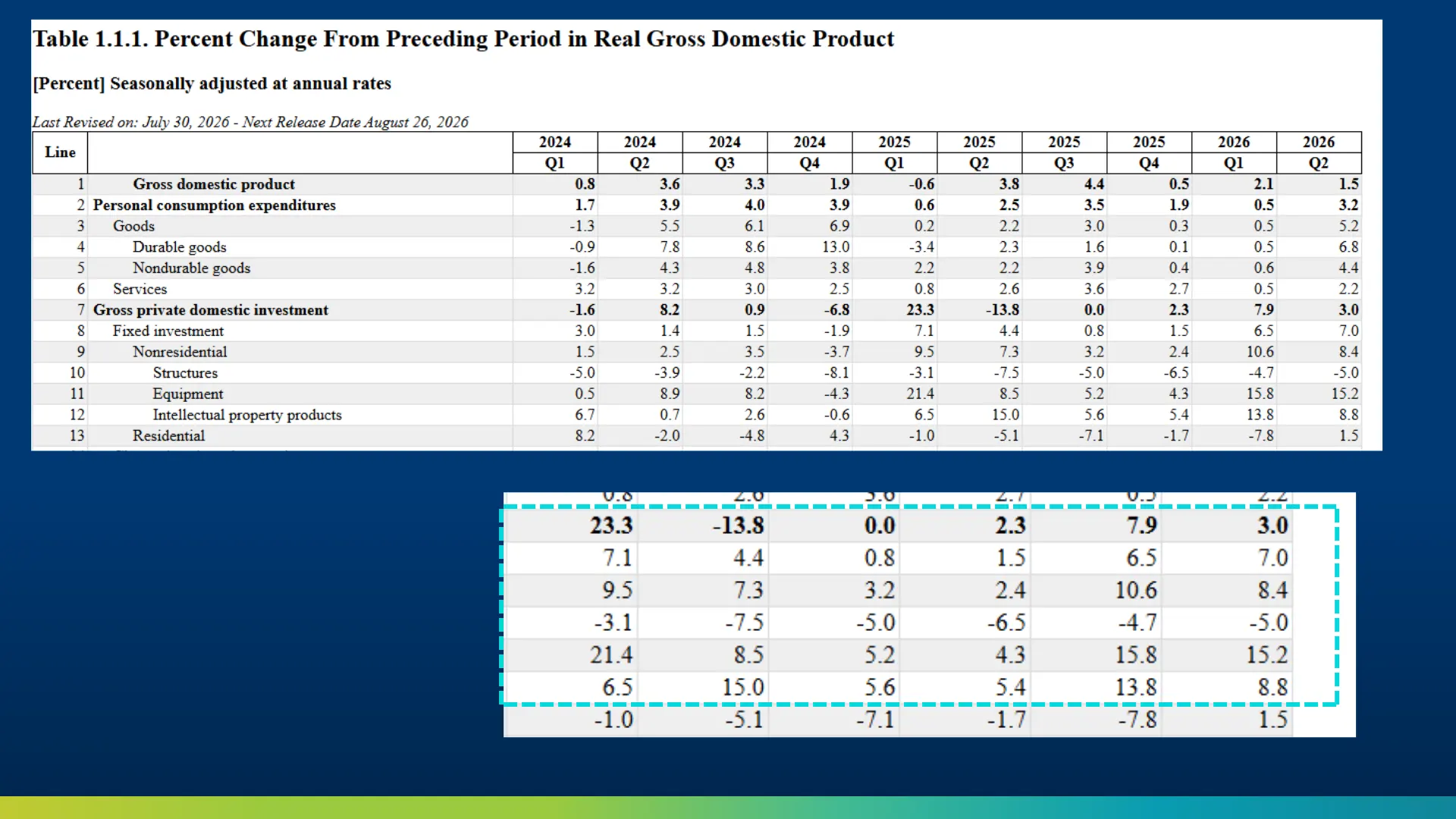
Yet GDP for the year to June in the US grew by 2.1% in real terms. How did the US economy grow so fast in the first and second quarters, when job numbers were basically flat?
We find the answer by looking at the effect of the boom in data centre construction. When we look at the US national accounts and we look at investment. We find what we're looking for under the section of non-residential investment. There are three categories here that we're going to look at to find Data Centres . These are : structures,( the actual buildings); equipment; and intellectual property products.
In the first quarter of this year, investment in structures fell by 4.7%, so clearly it wasn't the actual investment in buildings that drove the growth in the economy. To find that, we have to look at the two other sectors. When we look at investment in equipment, this rose by 15.8% in the first quarter and 15.2% in the second quarter. When we then look at investment in intellectual property products, this rose by 13.8% in the first quarter and 8.8% in the second quarter.
The result of this was that US GDP grew by 2.1% in the first quarter, remember, amid almost negligible job growth at this time, and by a further 1.5% in the US GDP in annualised terms in the second quarter. This was at the same time as job numbers stood still. When GDP grew so much faster than jobs, we call this a rise in productivity, unusual in Australia, but it's what's happening in the United States.
We are quite happy to forecast that the US economy will see a rise in GDP at a rate of 2% or better in the third quarter. What we are seeing in the US economy is a boom in data centre construction This is providing a boost in productivity and a boost in real output.
The final result for the American workforce will also be a rising living standard.
Want to discuss how this impacts your portfolio?
DISCLAIMER: Information is of a general nature only. Before making any financial decisions, you should consult with an experienced professional to obtain advice specific to your circumstances.

.jpg)
.jpg)