This article is a converted version of Michael Knox’s full presentation, which can be viewed in the video above.
Key takeaways
- Australian export prices are linked to movements in the US budget deficit, with changes flowing through about 15 months later.
- The primary driver of rising Australian export prices is the combination of strong US fiscal stimulus and stable domestic production.
Introduction
Australian export prices have been rising steadily, and new modelling suggests the trend is far from over. While global demand, China’s industrial activity and commodity cycles are usually the focus, another major driver is often missed: the size of the US budget deficit.
This article explains how recent US fiscal policy, particularly the passage of the “one big beautiful bill,” has created a powerful tailwind for Australian export prices.
How the US Big Beautiful Bill Changed the Commodity Outlook
Elevated US budget deficits = stronger Australian export prices
Modelling shows that when the US runs a large budget deficit, global demand lifts, which in turn pushes commodity prices higher. For Australia, this means stronger pricing for exported goods including iron ore, LNG, coal, copper, lithium and agricultural products.
If the bill had not passed, US tax cuts from Trump’s first term would have expired. Corporate taxes would have returned to levels near 40 percent instead of remaining in the low 20 percent range. This would have reduced after tax earnings, pushing down US stock prices and likely sparked a recession.
Instead, US budget deficits remain elevated:
- 2026: 7.9 percent of GDP
- 2027: 8.0 percent
- 2028: 8.1 percent
- 2029 to 2030: stabilising between 7.6 and 7.7 percent
These sustained deficits act as a demand engine, lifting commodity markets.
Why US Current Account Deficits Matter Too
The updated model now includes the US current account deficit.
Interestingly, US current account deficits are much lower than expected for a nation running large fiscal deficits:
- 2026: 3.2 percent
- 2027: 3.6 percent
- 2028 to 2030: between 3.5 and 3.6 percent
Why is the current account deficit so low?
Since around 2010, the American fracking boom has transformed oil and gas production. Higher domestic energy output has significantly reduced US reliance on imported oil. With fewer imports, the current account deficit shrinks.
This stability gives the US more room to run large budget deficits without destabilising the currency or creating financial stress. As a result, the global environment remains supportive for commodities and for Australian export prices.
What the Updated Model Shows
The updated model explains about 88 percent of monthly variation in Australian export prices (in US dollar terms)
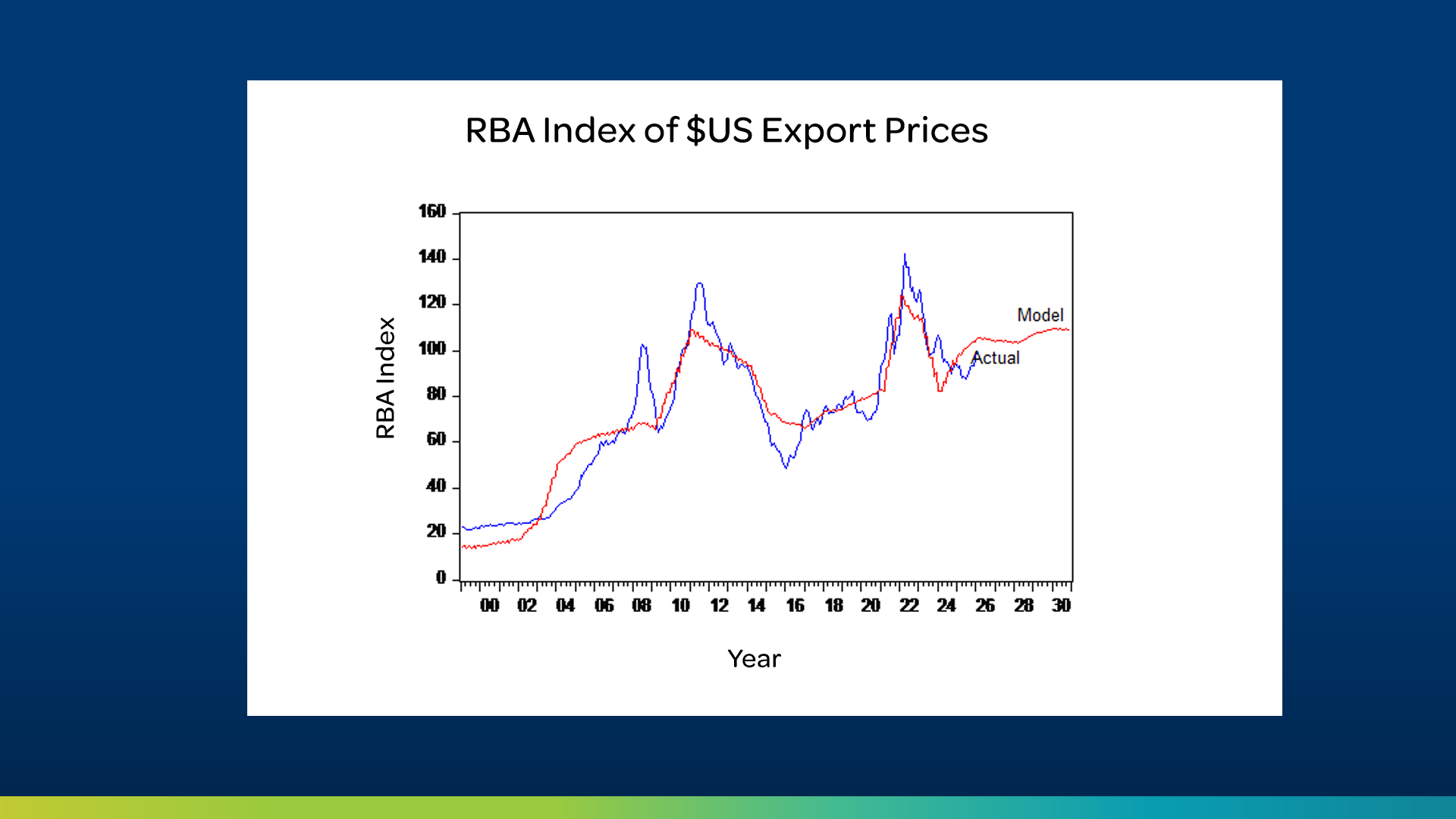
Recent results show:
- Since August last year, Australian export prices (RBA index, USD) have increased approximately 13 percent.
- We anticipate further rises of at least another 11 percent.
The outlook
The model expects:
- further upward movement in Australian export commodity prices in the near term
- sustained strong prices extending to 2030
This means durable strength in export earnings rather than a temporary spike.
What This Means for Australia
1. A stronger national income outlook
Higher export prices strengthen national income and improve the terms of trade.
2. Support for the Australian dollar
Rising export prices typically lift the Australian dollar.
FAQs
1. What drives Australian export prices the most?
The main driver is global demand from economies such as the US. Modelling shows the US budget deficit is the strongest predictor of Australian export prices.
2. Why do US budget deficits affect Australian commodities?
Large fiscal deficits stimulate economic activity. This increases demand for imported raw materials, which benefits Australia as a major global exporter.
3. How does fracking influence Australia’s export outlook?
Fracking has reduced US oil imports. This lowers the current account deficit, stabilises the US dollar and allows the US to maintain large fiscal deficits without triggering financial instability. The result is a more supportive environment for commodities.
4. Will Australian export prices keep rising?
Based on the latest modelling, export prices are expected to rise further before stabilising through to 2030.
5. Does this trend benefit all exports equally?
Industrial commodities such as iron ore, gas and metals benefit most. Agricultural products lift, but are also influenced by seasonal supply.
Conclusion
The passage of the “one big beautiful bill” has strengthened the outlook for Australian export prices. Modelling points to sustained strength in Australian export prices through to 2030.
Want to discuss how this impacts your portfolio?
DISCLAIMER: Information is of a general nature only. Before making any financial decisions, you should consult with an experienced professional to obtain advice specific to your circumstances.


.jpg)