ASX reporting season August 2026: what to expect
August earnings will test whether domestic resilience can be sustained under tighter RBA conditions, with mixed regional tailwinds creating a divided market. Industrials are expected to return to meaningful FY27 growth after a FY26 decline, but elevated result-day volatility and downside disappointment bias warrant caution. Legislated Capital Gains Tax changes are driving structural rotation from growth to yield, making dividend guidance a key focus.
In our recently published Reporting Season Playbook we preview the results for 167 stocks under coverage that report in August and call out likely surprise and disappointment candidates.
Key takeaways
- The ASX reporting season in August 2026 arrives during a "multi-speed" economy, with resources companies outperforming industrials
- The ASX 200 returned 6.1% in FY26, well below its long-term average of around 10%, while Resources delivered their strongest year since 2006
- Company earnings are forecast to grow meaningfully into FY27 after a period of little to no growth
- Legislated changes to capital gains tax from 1 July 2027 are already shifting investor focus toward dividends and yield
- Share prices are historically more volatile than usual on results day, so timing and expectations matter
A multi-speed market
Australian companies are traversing a tougher phase as sticky inflation takes longer to unwind. Australia was earlier to lift rates versus developed-world peers, contributing to recent below-average corporate earnings and returns. But conditions vary markedly across states and thematics. Sticky inflation, higher living costs and tax changes are dampeners for housing, banks and consumers more broadly. But commodity exports and pricing are still strong, supporting relative resilience in QLD and WA. Surging capex into data centres, and public and energy infrastructure offers support in the eastern states, albeit with VIC the laggard. This creates a mixed outlook for large companies operating nationwide and a market divided into winners and losers.
Consider recent returns. The ASX200 returned 6.1% in FY26, well below its long-term average of +10%. Gains were dominated by Resources, particularly the majors, gold and lithium miners. In fact, Resources delivered their best returns since 2006 (+45%). Meanwhile, Industrials lagged, returning -4%, below their long-term average of +9%. The big question for us in August is whether the domestic economy can maintain its resilience in aggregate while the RBA aims to stick a soft landing and bring inflation back into range. This would encourage the market to ‘look through’ to lower rates and higher earnings.
Industrials traversing an earnings lull
Looking through the earnings lull is supportive for out-of-favour industrials across Consumer, Housing, Growth (IT/Software/Online) and Small Caps. August results are therefore a key milestone in an Aussie Industrials recovery. The market forecasts a return to meaningful EPS growth in FY27, after a decline in FY25 and below-trend growth in FY26 (ex-Resources). Mind you, we’ve seen this movie before and remain cautious about further erosion in earnings expectations through August. That said, investors are better protected by a retreat in the market multiple to sub-17 times, suggesting result expectations are more modest than in the past few seasons.
ASX200 Industrials Total Returns - (ASX200 ex-Resources)
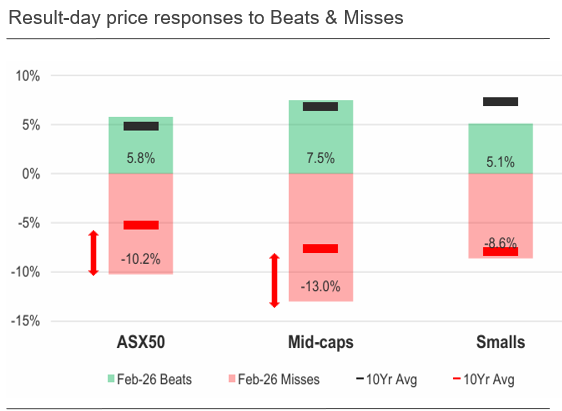
Elevated result-day volatility again looks likely. Volatility does work in both directions, but we see the risk of downside disappointment bias if February results are anything to go by. Tactical opportunities for assertive investors around volatility look safer if played after, rather than ahead of, reported results, on a risk-adjusted basis.
Yield likely to take the spotlight
Legislated CGT changes have prompted a rethink of after-tax outcomes and the balance between yield and growth. With the 50% discount replaced by indexation and a 30% minimum tax on gains from 1 July 27, the after-tax appeal of capital growth falls while franked income is untouched, tilting the balance towards yield. The run-in to August has already seen a rotation from growth to income, and August could bring more re-positioning. Payout ratios and dividend guidance are the signposts we are watching. We will look for evidence of where boards land on the trade-off between reinvestment for growth and capital management.
Want the full picture on reporting season?
This article covers the headline themes, but our research team has pulled together a complete breakdown of what to expect from ASX 200 companies this August, including sector-by-sector dashboards, earnings momentum trends and key results to watch.
Frequently asked questions
When is ASX reporting season in 2026?
The main results window for full-year (FY26) results runs through August 2026, with the bulk of ASX 200 companies reporting results in the second half of the month.
Why do share prices move so much during reporting season?
Investors are reassessing forecasts in real time as new information arrives, and computer-driven and passive trading can amplify short-term reactions to earnings beats or misses.
How can I prepare for reporting season as an everyday investor?
Review your portfolio's sector exposure, understand which of your holdings are reporting and when, and consider speaking with an adviser about how dividend and tax changes might affect your overall strategy.