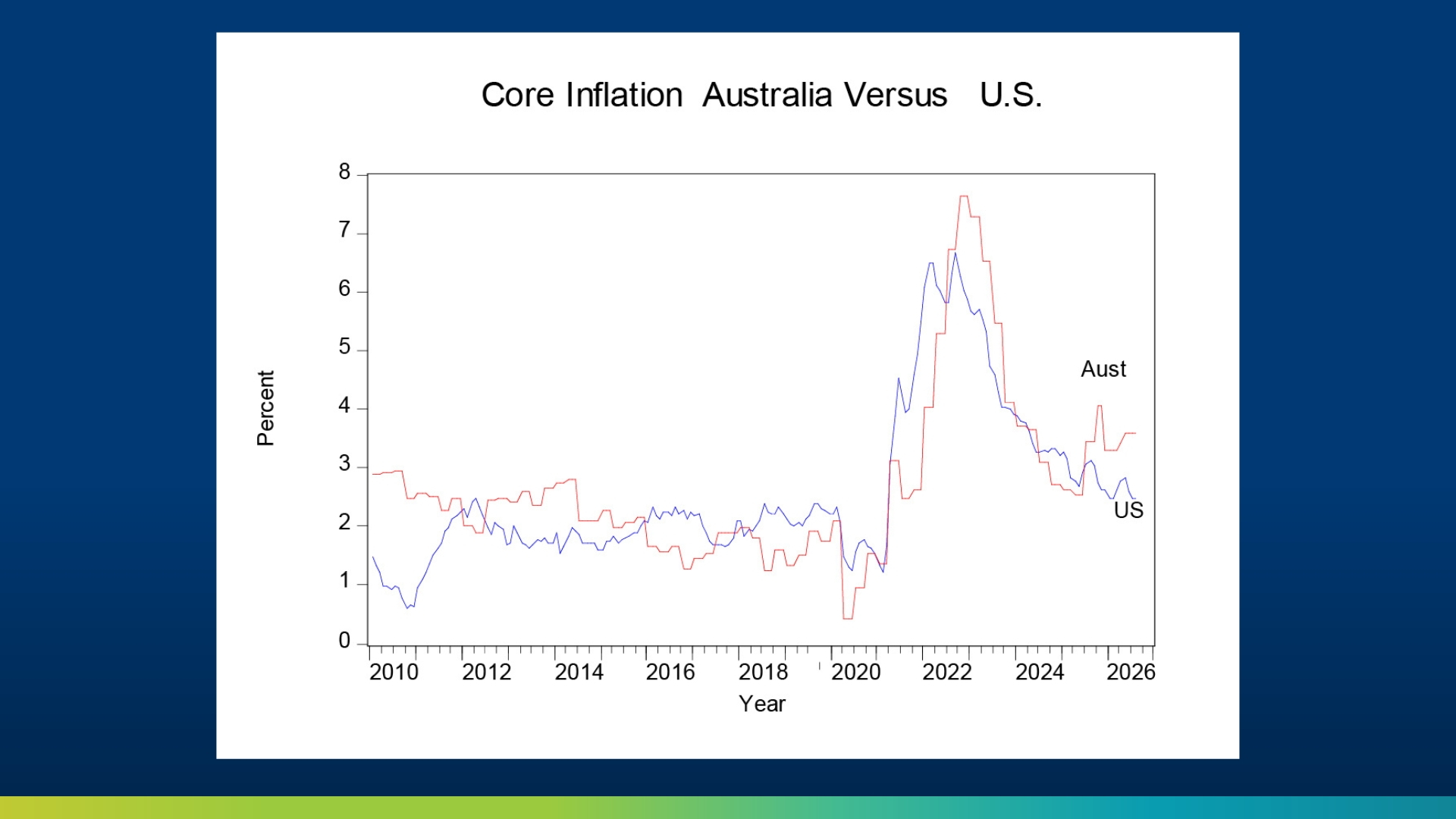
This presentation opens with a chart comparing core inflation in Australia to core inflation in the US. The chart reveals a significant break between the two: over the past year and a half, Australian core inflation (the red line) has climbed to a level well above US inflation.
The most recent releases from the ABS show Australian core inflation has stabilised at 3.6 per cent. The issue is that this sits 110 basis points higher than where US core inflation has stabilised. In fact, US inflation has continued to fall at the same time Australian inflation has been rising.
The latest US core CPI inflation figure, published just this week, came in at 2.5 per cent, some 1.1 percentage points below Australia's. Higher inflation requires higher interest rates to match it. That's exactly what our modelling shows when comparing where the Australian cash rate should sit relative to the US Fed funds rate. Our Australian cash rate model draws on data back to 1990 (when the cash rate was first introduced) and factors in unemployment, inflation and inflation expectations. It explains a surprisingly strong 89.2 per cent of the variation in the Australian cash rate.
Running the model puts the equilibrium cash rate for Australia at 4.89 per cent. In practical terms, that means the cash rate needs to rise by at least half a percentage point from where it sits now, equivalent to two more rate hikes, to bring inflation back under control.
Our model for the US Federal Reserve shows a similarly strong level of explanatory power, even though it starts from an earlier point (January 1992). Remarkably, it explains almost exactly the same share of variation in the Fed funds rate, 89.2 per cent, and puts the equilibrium Fed funds rate at 3.92 per cent. That's 32 basis points above the current rate, so we can forecast with some confidence that at least one more 25 basis point hike is needed.
We expect one Fed rate hike before the end of the year, and certainly before the middle of next year.
Inflation in Australia is a different story. Rates aren't heading down anytime soon, because inflation here remains steady at a level well above where it sits in the US. Our model points to rates needing to rise toward 4.89 per cent, roughly 50 to basis points higher than current levels. This means two more rate hikes.
So the challenge for Australia is clear: persistently higher core inflation means there's still room, unfortunately, for rates to rise further. US rates have room to move too, just not as far as Australia's.
DISCLAIMER: The information contained in this report is provided to you by Morgans Financial Limited as general advice only, and is made without consideration of an individual's relevant personal circumstances. Morgans Financial Limited ABN 49 010 669 726, its related bodies corporate, directors and officers, employees, authorised representatives and agents ("Morgans") do not accept any liability for any loss or damage arising from or in connection with any action taken or not taken on the basis of information contained in this report, or for any errors or omissions contained within. It is recommended that any persons who wish to act upon this report consult with their Morgans investment adviser before doing so.
.jpg)
.jpg)
.jpg)