Federal Reserve Interest Rate Outlook: What Investors Need to Know
The Federal Reserve’s latest projections reveal a surprisingly moderate outlook for inflation and interest rates. Despite tariff concerns earlier this year, the Fed expects inflation to remain subdued and rates to decline gradually. Here’s what this means for markets and investors.
Key Takeaways
- Fed forecasts interest rates around 3.4%, aligning with market expectations.
- Inflation impact from tariffs is far lower than predicted.
- Core inflation expected to fall to 2.5% next year and reach target levels by 2028.
- Growth outlook remains positive with no recession in sight.
- A benign economic environment could support U.S. equities.
What the Fed’s Latest Projections Tell Us
Every quarter, the Federal Reserve releases its Summary of Economic Projections (SEP), which includes forecasts from the Federal Open Market Committee and regional Fed banks. These projections carry significant weight because they reflect the collective view of some of the most influential economists in the U.S.
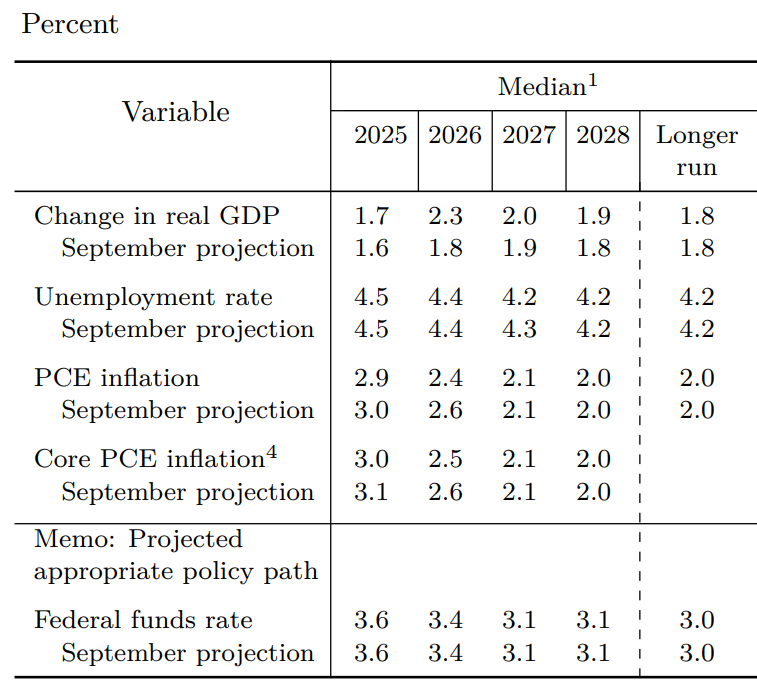
Table 1. Economic projections of Federal Reserve Board members and Federal Reserve Bank presidents, under their individual assumptions of projected appropriate monetary policy, December 2025
Interest Rate Outlook: Gradual Declines Ahead
Our model estimated the equilibrium Fed funds rate at 3.35%, and the Fed’s own forecast is close at 3.4%. This suggests rate cuts are likely in the near term, with further declines to 3.1% in subsequent years. For investors, this signals a stable environment for borrowing and equity markets.
Inflation: Lower Than Expected Despite Tariffs
Earlier predictions suggested tariffs could push inflation up by 1.6%, but the actual impact has been minimal. Headline inflation is projected at 2.9%, and core inflation at 3%, well below initial fears. The Fed expects core inflation to fall to 2.5% next year, then to 2% over the longer term.
Growth Outlook: No Recession on the Horizon
Despite global uncertainties, the Fed anticipates steady growth: 1.7% this year, 2.3% next year, and 2% thereafter. This benign outlook, combined with easing inflation, suggests a supportive environment for U.S. equities.
FAQs
Q1: Why is the Fed cutting rates?
To maintain economic stability and support growth amid moderating inflation.
Q2: How will lower rates affect investors?
Lower rates typically reduce borrowing costs and can boost equity markets.
Q3: Are tariffs still a risk for inflation?
Current data shows tariffs had a smaller impact than expected, thanks to strong service-sector productivity.
Q4: Is a U.S. recession likely?
The Fed’s projections show no signs of recession in the near term.
Q5: What is the Fed’s inflation target?
The Fed aims for 2% core inflation, which it expects to achieve within a few years.
The Federal Reserve’s outlook points to a stable economic environment with easing inflation and gradual rate cuts. For investors, this could mean continued opportunities in equities and fixed income. Want to learn more about how these trends affect your portfolio?
.jpg)
.jpg)